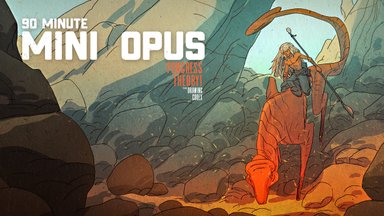
Your Creative Process Should Be Uniquely Yours
Summary
The Process Problem
Artists often struggle not from lack of skill but from following creative processes that were never designed for them. The standard advice on worldbuilding and storytelling comes largely from writers who think in character arcs and plot structures. For visual artists who think in images and scenes, this creates an uncomfortable mismatch between how creativity naturally flows and how it supposedly should work.
The educational system trains us to look for the right way to do things. Creative endeavors, however, demand something different: discovering what actually works for you. The specific way ideas spark, how they develop, what comes first and what follows - these patterns shape the flavor and texture of every world you build.
Core Insights
Different Entry Points for Different Creators
James Cameron dreamed the T-800 walking through flames, its metal skeleton revealed as flesh burned away. From that single fever-dream image emerged an entire film. Ridley Scott storyboarded Alien by hand, finding the movie through drawing rather than writing. Both directors entered their stories visually because film is a visual medium - and because they think in pictures.
Writers like Brandon Sanderson approach worldbuilding through complex systems of magic and culture. Game designers like Kojima think about persistent feelings and interactive experiences. Each medium demands different entry points. A novelist might build toward revelatory character moments; a visual director builds toward iconic scenes. Neither approach is wrong, but following the wrong one for your medium creates friction that kills creative momentum. The key insight: how you enter the creative process shapes everything that follows.
Anchoring to Your Medium's Strengths
Great visual directors anchor to memorable scenes. Kubrick reportedly built films around cool set pieces, fitting story around them afterward. Miyazaki of Studio Ghibli describes his process as building one section at a time, seemingly without linear planning - utter insanity from a structural perspective, yet it produces remarkable work.
The concept of anchoring means using constraints to focus brainstorming. What creatures would create interesting dramatic scenarios in this environment? What designs would support this particular gameplay mechanic? These questions use craft requirements as creative fuel rather than limitation. When visual artists anchor to what would make great images, or writers anchor to what would create authentic character conflict, ideation becomes purposeful without becoming restrictive. The medium provides boundaries that paradoxically enable freedom.
Discovering Through Experimentation
Personal creative process emerges through trial and error, not theoretical understanding. One approach that seemed promising: drawing characters first, then building stories around their visuals. Standard writing advice suggested the opposite - develop characters on paper, then draw them. But visualizing characters that already existed mentally created impossible perfectionism. Drawing first, then discovering who these people were, worked better.
Another discovery: writing the entire story from each major character's first-person perspective. Only after understanding what every character wanted did the dramatic structure click into place. These methods appear in no textbook. They emerged from frustration with professional approaches that felt logical but produced lifeless results. The uncomfortable truth: whatever process works for you will likely seem weird, illogical, maybe even unprofessional. The creative chaos of successful projects reveals that weirdness is not a bug but a feature.
Key Takeaways
Analytical: Creative worldbuilding is an infinitely complex problem with infinite correct answers, not a pass-fail test. Traditional educational thinking expects single right answers, but creative process requires finding your sequence among many possible successful outcomes.
Simple: This is about discovering what works, not finding a theory. Experimentation reveals your process; prescription cannot provide it.
Practical: The first few attempts will likely fail. Building creative process requires working the muscle, feeling the discomfort, and learning what functions for you specifically. There are no shortcuts past the necessary experiments.
Philosophical: Creating fiction means telling lies that reveal truth. Accessing genuine creativity often requires going slightly nuts - fever dreams, entering imaginary worlds, tolerating uncomfortable uncertainty. The weird processes of successful creators are not accidents but requirements.
Try This
Start With Your Strength: Identify whether you naturally think in images, character voices, plot structures, or something else. Begin your next project there instead of where advice says to start.
Experiment With Anchors: Pick one constraint from your medium (must be drawable, must create conflict, must work in this setting) and brainstorm freely within those boundaries.
Write Every Perspective: For any project with multiple characters, try writing key scenes from each character's first-person point of view. Notice if understanding their motivations unlocks stuck areas.