Color Proportion in Master Illustrations
Summary
Balancing Color Proportion
When we look at work from artists like Frank Frazetta, Mike Mignola, or Studio Ghibli, something makes their colors feel right. It goes beyond picking beautiful hues or mastering color theory. The missing piece is proportion -- how much of each color appears in the image matters just as much as which colors are chosen. Most artists learn about color harmony, complementary schemes, and temperature, but miss the crucial element that separates amateur work from professional illustration: the proportional balance between colors. A perfect palette with colors distributed equally across the canvas still falls flat. Color proportion -- the relative amounts of each color in a composition -- creates visual hierarchy, mood, and impact.
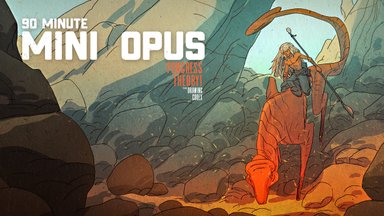
The Color Pyramid is a framework for thinking about color distribution. At the base sits the dominant color, occupying roughly 60-70% of the image. This sets the overall mood and atmosphere, creating a unified foundation for everything else. The middle tier consists of secondary colors, taking up about 20-30% of the composition. These support the dominant color while providing contrast and visual interest, giving depth and dimension without overwhelming the main color statement. At the top sit accent colors -- small, strategic pops that occupy just 5-10% of the image. These are focal points, drawing the eye to areas of importance. The glow of a lantern in a dark scene, or a red scarf on a character in a blue-green environment.
Frazetta demonstrates this through restraint. In pieces like "Testament," a single color family dominates -- warm oranges and browns filling most of the canvas -- while cool blues appear sparingly in shadows and backgrounds. Accent colors, often bright reds or whites, appear in tiny amounts but create immediate focal points on weapons, eyes, or light sources. Mignola, working with colorist Dave Stewart, takes a different but equally effective approach. In Hellboy, large areas of flat dominant color establish mood immediately while bright accents -- usually red from Hellboy himself or yellow from fire -- create focal points. The proportion is carefully controlled: vast amounts of one or two colors, with strategic punctuation from accent hues.
Edgar Payne's landscape paintings show how this works in traditional fine art -- a dominant atmospheric color covering most of the canvas, secondary colors defining major forms, and small accents of bright color creating interest without disrupting the unified mood. Studio Ghibli's Porco Rosso carries the same principle into animation, where the warm Mediterranean palette dominates most frames and accent colors appear strategically: the red of Porco's plane, specific foliage greens. Hiroaki Samura's Blade of the Immortal and Capcom's character design work demonstrate how color proportion applies to graphic and stylized illustration, where large areas of black and white establish dominance, muted tones provide form definition, and bright accent colors highlight the details that matter most.
The Color Pyramid bridges technical color theory with practical picture-making decisions. Many artists get lost in endless color studies without understanding how to apply that knowledge to create compelling images. This framework works whether the goal is painting landscapes, designing characters, or creating stylized illustrations. It connects directly to value structure -- the dominant color often corresponds to the dominant value range, creating a unified visual hierarchy that makes images read clearly. This is how we move from technical knowledge to artistic decision-making.
Key Concepts
The Color Pyramid: Color distribution follows a hierarchy -- roughly 60-70% dominant color sets the mood, 20-30% secondary colors provide contrast and depth, and 5-10% accent colors direct attention to focal points.
Proportion Over Palette: The specific hues matter far less than how they are distributed. Every successful image from Frazetta to Ghibli follows this proportional approach, even though their actual color choices vary wildly.
Equal Distribution Kills Impact: When colors are spread evenly across a composition, the image feels unfocused. Committing to a dominant color and using accents sparingly is what gives professional work its visual clarity.
Try This
Analyze an Existing Piece: Take a current illustration and estimate what percentage of the image each major color occupies. If four colors each take up roughly 25%, that even distribution is likely why the piece feels unfocused.
Push the Dominant Color: Choose one color to occupy 60-70% of the image. Reduce the others to supporting roles and limit accent colors to 5-10% of the composition.
Compare the Result: Even adjusting an existing piece this way -- without changing the actual palette -- reveals how much impact color proportion creates on its own.