Three Art Rules You Keep Forgetting
Summary
Consistency Over Complexity
Getting good at art is less about learning more advanced techniques and more about doing the basic things consistently on every single image. Professional artists are not more talented. They have just practiced the fundamentals enough that skipping them feels wrong. The number one reason intermediate artists struggle to achieve a professional look is that they have forgotten something really basic. Not something obscure or advanced, but something they already know and simply did not apply.
The secret to leveling up is often just remembering to do the basics every time. Many artists chase more knowledge, more rendering tricks, better perspective skills, but when work is not hitting that professional level, it is almost always something fundamental that got skipped. What separates a professional from someone who is struggling is not skill or technical capability. It is that the professional does all the basic stuff on every image, and they know exactly what will trip them up if they miss it.
The first fundamental that applies to everyone is knowing where the light source is. At any point while working on an image, it should be possible to point to where the light is coming from. Without that clarity, different parts of an image end up lit from contradictory directions. A face rendered as if light comes from above while the arm suggests light from the side. Even in flat or cartoony styles, consistency matters. Decide the light comes from above and apply that logic to everything. For more painted or rendered styles, the demands are greater: reflected light, multiple light sources, sky light, and how they all interact with every form. If the light source is not clear, that is the root cause of most rendering problems.
The second fundamental is establishing the horizon line. This determines whether the viewer is looking at eye level, looking down, or looking up at the subject. It matters for every drawing, even a single character with no background. Without a clear horizon line, one part of a character gets drawn as if seen from above while another part is drawn from below. That inconsistency is what creates the amateur look. In comics, every panel needs a clear horizon line placement. Making this automatic and effortless is fundamental to solid drawing whether creating full scenes or just a character.
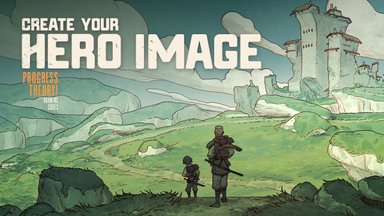
The third fundamental is building foreground, middle ground, and background into every image. A character with no foreground element and a flat background reads as a sketch. Add something in front, place the character in the middle, put elements behind, and suddenly it reads as a complete illustration. This principle makes even rough, fast concept art finished in two to three hours look professional. Photographers always find foreground elements to add depth, and artists should do the same. When depth layers are missing, images look flat no matter how well individual elements are rendered.
Key Concepts
Know Your Light Source: At every point while working, it should be possible to point to where the light is coming from. Inconsistent lighting is at the root of most rendering problems, even in flat or cartoony styles. Consistency in lighting direction is what allows stylization to work.
Establish Your Horizon Line: The horizon line determines whether the viewer is looking up, down, or eye-to-eye with the subject. Without it, different parts of a drawing get rendered from conflicting viewpoints. This applies to every drawing, not just scenes with backgrounds.
Build Three Depth Layers: Foreground, middle ground, and background transform sketches into illustrations. This is one of the most commonly forgotten fundamentals, yet adding separation between depth layers is what makes even simple art read as professional work.
Try This
Write a Checklist: Put the three fundamentals on a piece of paper and stick it where you work. The goal is not to rely on the list forever but to practice until these steps become automatic.
Check Before Finishing: Before completing any piece, ask three questions. Where is the light source? Where is the horizon line? Is there a foreground, middle ground, and background? If any answer is unclear, stop and address it.
Build the Habit: After enough repetitions of stopping to fix these basics, they stop feeling like extra work and start feeling essential. The process becomes natural when missing a fundamental step feels immediately wrong.